


Project Overview:
Ubuntu Roots is proud to launch its first education initiative in Ghana; connecting students from under-resourced schools to volunteer educators around the world through online lessons.
The goal is simple: to make quality education accessible no matter where a student lives.
This program currently supports students from Nkwanta Village Primary, Golden Future Junior High, Keta Rising Stars Basic School, and Adom Elementary School, focusing on core subjects like English, science, and social studies, and on sparking curiosity, creativity, and confidence.
Impact at a Glance:
- 4 partner schools across Ghana
- 10+ international volunteer teachers
- 760+ students reached in the first term
1️⃣ Beginnings: Building Bridges Through Screens

It started with a test call.
In February, a volunteer in Japan connected with a classroom in Adom Elementary School: 66 students gathered around a single laptop. The power flickered twice, and the Wi-Fi lagged, but when the teacher greeted them with “Good morning from Tokyo!”, the students erupted into cheers.
That first 30-minute Economics lesson, set the tone for the months that followed. The idea of global classrooms suddenly became real.
2️⃣ Expanding the Network: New School Join
After the success in Adom elementary school, the initiative is expanded to another local school!
We are happy to announce the participation of Nkwanta Village Primary, although they faced unstable electricity, so classes were scheduled early mornings before the heat cut the power. Volunteers taught storytelling through simple drawings and illustrations, turning every lesson into a kind of performance.

3️⃣ Further Expansion: New schools join
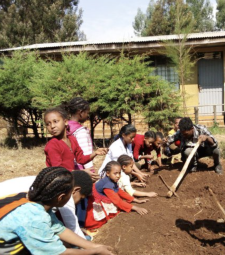
By April, the initiative had expanded to two more schools: Golden Future Junior High, and Keta Rising Stars Basic School.
Golden Future Junior High became known for its curiosity. Students requested extra science sessions after a volunteer taught a class on volcanoes using virtual experiments.
At Keta, where many families rely on fishing, Keta Rising Stars Basic School had students logged in after helping their parents in the mornings, learning the economics and applying it to their parent’s situation.
4️⃣Mid-Year Milestone: Stories from the Classrooms
By June, over 80 lessons had been completed, and each school had begun shaping its own culture of learning.
At Adom Elementary, the highlight was the addition of Environmental Sustainability classes, where students stepped outside the classroom to apply what they learned to outside of the classroom.
Teachers on the ground reported higher engagement and improved confidence, especially among students who rarely spoke in class before.

5️⃣ A Growing Movement
By September, the Ghana initiative had become more than a pilot — it had become a community.
Students now greet volunteers by name, share weekend stories, and even ask about the weather in their teachers’ countries.
Local coordinators have begun inviting parents to watch end-of-term showcases — where students present short speeches, poems, and science projects inspired by what they learned online.
Ubuntu Roots is now preparing to add two new schools to the program in early 2026, expanding its reach and introducing new subject areas like philosophy and psychology.
The Ghana Education Access Initiative has shown that a classroom doesn’t need walls to inspire learning.
Every video call, every shared laugh across time zones, is proof that distance doesn’t limit connection, curiosity does the opposite; it builds bridges.
From the coast of Keta to the villages of Nkwanta, education is no longer something to wait for. It’s something students log into.